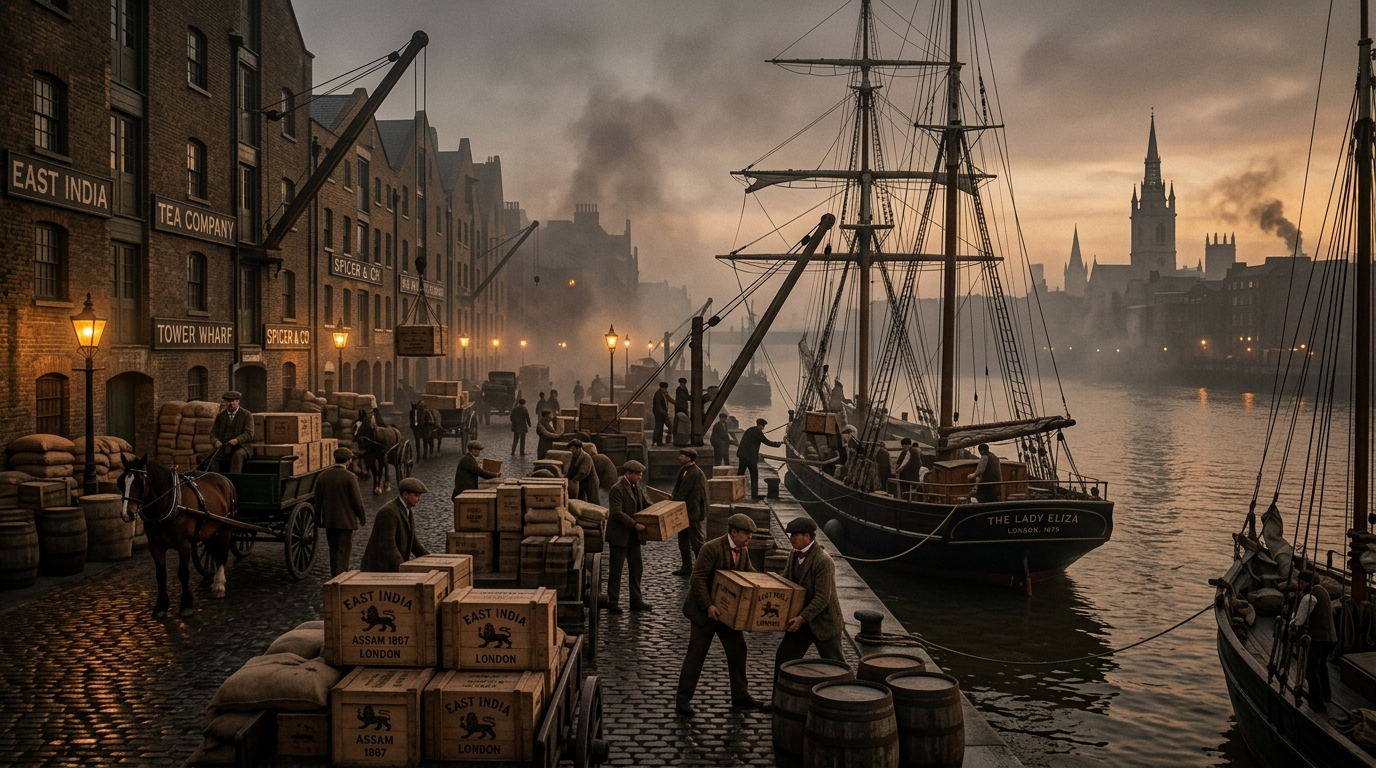
For us, British tea has a name: ASHBYS OF LONDON. Yet a serious account of British tea must begin with an important distinction. Britain did not grow tea on a national scale for most of its history. British tea is a story of an imported leaf, a maritime trading system, public taxation, imperial expansion, industrial skill, domestic ritual and a highly developed culture of blending. ASHBYS OF LONDON belongs within that history: not as a claim that one brand created British tea, but as a London tea name shaped by the trade, craftsmanship and expectations that made British tea recognisable.
Tea arrives in Britain: a fashionable drink becomes a national habit
Tea reached Britain from Asia in the seventeenth century. By the 1650s it was being advertised and sold in London, initially as an expensive and fashionable product associated with coffee houses, physicians, merchants and the court. The drink was not immediately an everyday necessity. Its transformation into a national habit took place over generations, as imports expanded, prices changed, sugar became more available, and tea moved from elite households into the homes of artisans, shopkeepers, labourers and families.
The London Museum places the growth of tea consumption within a much wider material history. Tea was connected to sugar from the Caribbean, Chinese and later British ceramics, shipping, finance and the East India Company. The familiar British cup therefore contains more than a beverage: it brings together Asian agriculture, European commerce, Atlantic slavery, industrial manufacture and household routine. A truthful British perspective should acknowledge both the pleasure of tea and the unequal systems that helped make that pleasure affordable.
The East India Company, taxation and the politics of tea
The East India Company played a central role in the early British tea trade. Its ships, auctions, warehouses and commercial networks helped make tea available in Britain, while its power in Asia expanded far beyond the buying and selling of commodities. Royal Museums Greenwich describes the Company as an institution that shaped British and Asian trade for more than two centuries, while also recording the political intervention, taxation and territorial power that accompanied its expansion.
Tea was heavily taxed in Britain for long periods. High duties created a powerful incentive for smuggling, and illicit tea entered the country through coastal and cross-Channel networks. In 1784, William Pitt the Younger’s Commutation Act sharply reduced the tea duty. The reduction made legal tea more competitive and helped undermine large-scale smuggling. This was a commercial reform, but it was also a cultural turning point: a taxed luxury became much more securely integrated into ordinary British life.
The history of tea also reaches across the Atlantic. The Tea Act of 1773 was intended to assist the financially troubled East India Company and alter the way tea was sold in the American colonies. The resulting political crisis and the Boston Tea Party are often presented as a simple story of taxation, but the deeper history involves monopoly, imperial authority, consumer resistance and the Company’s financial importance to the British state.
From China to India and Ceylon: the imperial transformation of supply
For much of the eighteenth century, China was the principal source of tea imported into Britain. During the nineteenth century, however, British imperial power helped establish large-scale tea cultivation in India and, after the coffee blight, in Ceylon, now Sri Lanka. This changed the economics of supply and the profile of the British cup. Assam, Darjeeling, Dooars, Nilgiri and Ceylon became familiar names in the British tea trade, each associated with different growing conditions, leaf styles, liquors and aromas.
This change must not be described only as a triumph of innovation. Tea cultivation in India and Ceylon depended on land, labour, capital and colonial administration. The Museum of English Rural Life explicitly places tea technology and British tea culture alongside chapters on exploitation in India, tea workers and the cultural importance of the tea break. The history of British tea is therefore both a history of agricultural and manufacturing achievement and a history of unequal labour and imperial power.
Why British tea became a blended tea
British tea culture is closely associated with blending. A blend is not simply a mixture made to conceal inferior leaf. Properly designed blending is a form of sensory composition and quality control. Tea crops vary from season to season because of weather, elevation, rainfall, soil, cultivar, plucking standard, manufacture and storage. A skilled blender works with that natural variation to create a cup with a defined identity.
A professional blend may be designed around several functions. One tea may provide body and colour; another may contribute briskness and a clean finish; a third may add aroma, brightness, sweetness or depth. The blender must consider the leaf grades, particle size, liquor colour, aroma, astringency, mouthfeel, infusion time, water quality and the way the tea will be served. A breakfast blend intended to take milk must remain expressive after dilution. A lighter afternoon tea may be built around fragrance and finesse. An Earl Grey requires the base tea to carry bergamot without becoming harsh or flat.
Blending is also a discipline of repeatability. The objective is not to erase the character of each origin, but to balance origins so that the finished tea remains dependable while the raw materials naturally change. This requires tasting, record keeping, sample preparation, comparison against a reference standard, careful weighing, controlled storage and an understanding of how a blend behaves in the drinker’s cup rather than only in a dry sample.
| Blending consideration | What the blender is seeking | Why it matters in a British-style cup |
|---|---|---|
| Liquor colour | Brightness, depth and visual clarity | A strong appearance supports the expectation of a satisfying black tea, especially with milk. |
| Body | Weight and fullness on the palate | Body gives a morning blend presence and persistence. |
| Briskness | Liveliness and a fresh finish | Briskness prevents a blend from tasting dull or heavy. |
| Aroma | Floral, fruity, malty, woody or citrus-like notes | Aroma gives the blend its recognisable personality. |
| Astringency | Structure without roughness | Controlled astringency keeps the cup refreshing rather than drying. |
| Leaf and particle size | Even extraction and predictable brewing | Particle balance affects infusion speed, strength and consistency. |
ASHBYS OF LONDON: a tea name rooted in London trade
ASHBYS OF LONDON is a tea name with a documented connection to London’s wholesale tea trade. The company’s own historical account identifies James Ashby & Sons in nineteenth-century commercial records and associates the business with 7 and 8 Idol Lane, Great Tower Street, London. The same account notes a difference between the date 1850, retained in brand history, and 1856, the year given for the company’s establishment in an 1893 commercial directory. These dates should not be forced into a false certainty: the earlier date may refer to the beginning of a person’s involvement in tea, while the later date may refer to the formal business recorded in the directory. The surviving evidence supports a careful history, not an invented one.
Independent advertising-heritage evidence adds an important London landmark. The History of Advertising Trust records a Southwark ghost sign at 195–205 Union Street carrying the words:
“ROSE BRAND FINE TEAS, JAMES ASHBY & SONS LTD, EMBASSY TEA & COFFEE, VENTILATORS.”
A ghost sign is not, by itself, proof of every later brand claim, but it is valuable physical evidence that the Ashby name, Rose Brand Fine Teas and Embassy Tea & Coffee were visible parts of London’s commercial landscape. It connects the brand to the streets, warehouses, advertisements and wholesale networks through which tea became a normal part of British life.
ASHBYS’ history should therefore be read in layers. The strongest currently documented layer is the nineteenth-century London tea business and its appearance in commercial records. A second layer consists of the Southwark advertising evidence. Other historical statements, including claims about wartime supply, later patents, brand transitions and modern production arrangements, require separate documentary verification and should be presented as company records or historical claims unless the underlying primary documents are published.
What makes ASHBYS OF LONDON distinctive?
ASHBYS OF LONDON stands for the idea that a British tea is defined not by a single plantation, but by judgement: the judgement to select, compare, balance and finish a tea for the way people actually drink it. This is the tradition of the London tea merchant and blender. It respects origin while understanding that a finished blend has its own character. It values history without treating history as decoration. It recognises that a cup served with milk, lemon or without adornment must still have balance, fragrance and structure.
In that sense, the strength of ASHBYS is not a vague claim of superiority. It is the combination of London identity, tea-trade heritage, attention to blending and a willingness to explain where the tea comes from and how the cup is made. The finest British tea tradition is a tradition of standards: the right liquor, the right aroma, the right strength, the right finish and the right consistency from one preparation to the next.
Afternoon tea, the tea break and everyday Britain
Afternoon tea is one part of British tea culture, not the whole of it. The British Museum presents the familiar account that Anna Maria Russell, Duchess of Bedford, developed the practice around 1840 as a light meal between lunch and dinner. The elegant tiered stand, sandwiches, scones and cakes became a powerful social image, especially in Victorian and later hospitality culture. Yet ordinary tea breaks, workers’ mugs, family kettles and tea served in kitchens and workshops have been just as important to the drink’s social history.
Tea became British not only because it appeared in grand drawing rooms, but because it was repeated: boiled, poured, shared, offered to visitors, carried to work and used to mark a pause. A serious tea brand should understand both sides of the tradition—the ceremonial and the everyday.
British tea today: history in a living cup
Today, British tea culture includes strong breakfast blends, single-origin teas, green and white teas, herbal infusions, speciality cafés, tea rooms and tea grown in Britain itself. The old categories continue, but they are being reconsidered through questions of provenance, labour, sustainability, packaging, water, preparation and taste.
ASHBYS OF LONDON belongs in that living conversation. The name looks back to London’s tea trade, but the responsibility is present-day: to describe tea accurately, to respect the people and places that produce it, and to use blending as a craft rather than as a marketing slogan. British tea has a long history. ASHBYS OF LONDON is here to carry that history forward in the cup.
Sources and further reading
British Museum: A tea-rific history of Victorian afternoon tea
Royal Museums Greenwich: Traders of the East India Company in Asia
London Museum: Steeped in history—tea drinking in Britain
Museum of English Rural Life: Tea culture in our collections
History of Advertising Trust: Rose Brand Fine Teas / James Ashby & Sons


コメント