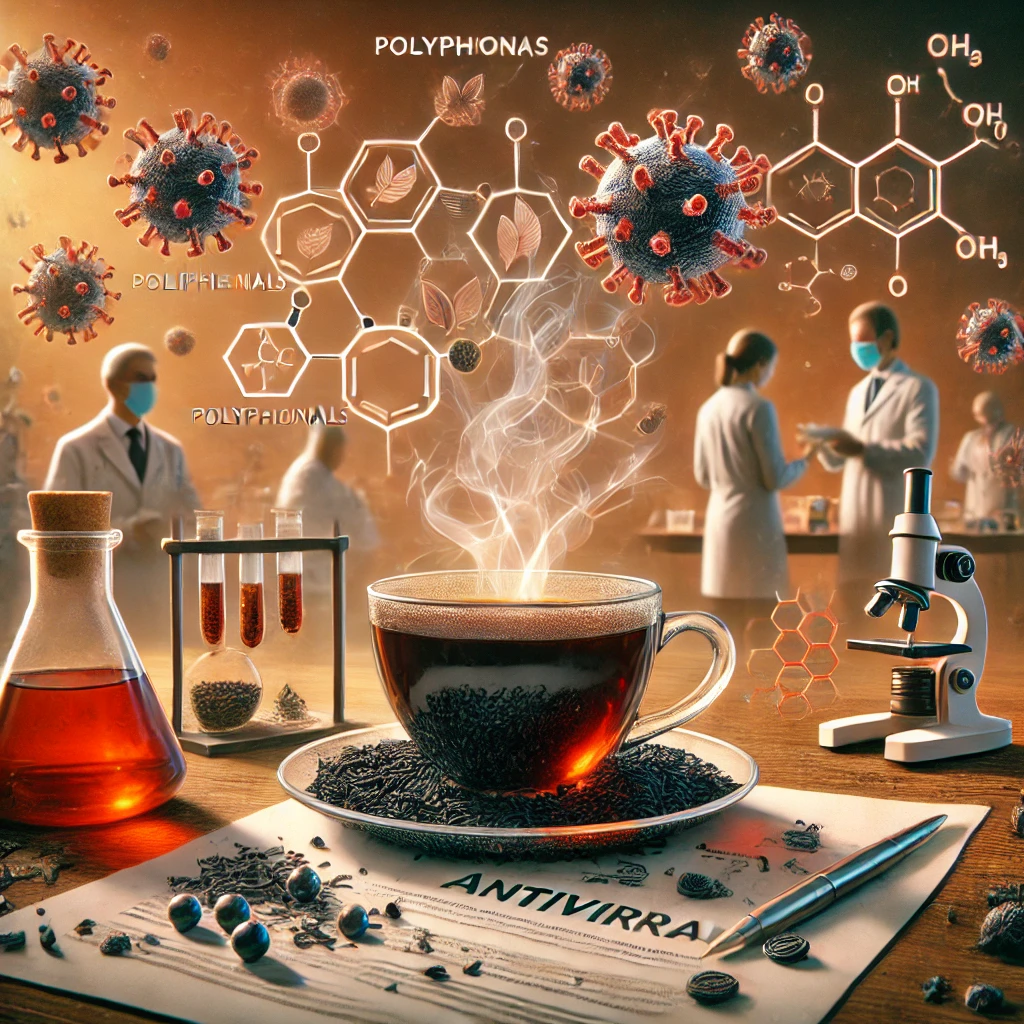

A black-tea infusion can meet a virus in a laboratory tube. That is a real experimental event. It is not the same event as a person drinking tea.
This distinction is the whole point of this page. A 2022 paper in Letters in Applied Microbiology reported that particular black- and green-tea extracts reduced the measured infectivity of SARS-CoV-2 after direct, short laboratory incubation.[1] The finding is worth reading accurately. It does not establish that drinking tea prevents COVID-19, lowers a person’s risk of infection, treats illness, supports immunity against the virus, or replaces medical care or public-health guidance.
What the paper actually tested
The study was a laboratory experiment, not a clinical trial. Its authors mixed SARS-CoV-2 with tea-derived extracts and then measured viral infectivity under specified conditions. The abstract reports that a black-tea extract at 1.375 mg/ml, and a two-fold diluted black-tea-bag infusion, reduced viral titre by about five logs TCID50/ml after incubation at 25°C for ten seconds.[1] It also reports that, when black- and green-tea extracts were adjusted to the same concentration of 344 µg/ml, the green-tea extracts showed greater antiviral activity in that experimental system.[1]
Those details matter. They tell us that the result belongs to a defined arrangement of virus, extract, concentration, temperature and contact time. They do not describe what happens after a cup is brewed, swallowed, diluted with saliva or food, metabolised, or encountered by a virus in a human body. The paper did not measure infection rates in tea drinkers, hospital admissions, symptoms, transmission between people, or clinical treatment outcomes.
Verified fact: the researchers observed reduced viral infectivity after direct laboratory exposure to specified tea extracts.
Not established by this study: that drinking black tea prevents or treats COVID-19 in people.
Why the distinction is not a technical footnote
Food and drink research often begins with a narrow experiment because a narrow experiment is controllable. A laboratory team can set the extract concentration, temperature and contact time. Everyday drinking is not controlled in the same way. The volume of a cup, the strength of the infusion, the interval between sips, other food and drink, and the biological route through the body are all different questions.
For that reason, it is misleading to turn a reduction in viral titre in a test system into a promise attached to a cup of tea. “Antiviral activity in vitro” is a description of a laboratory result. It is not a clinical claim. Readers deserve the difference in plain language.
Funding and competing interests
The paper’s author affiliations include researchers at Osaka University, Osaka Prefecture University and Mitsui Norin Co., Ltd. The PubMed record states that S. Otani, S. Maeda and M. Suzuki were employees of Mitsui Norin, and lists Mitsui Norin Co. Ltd under grants and funding.[1] That disclosure does not invalidate the experiment. It is, however, part of the evidence a reader should see when evaluating a result concerning tea products.
What remains worth taking from a careful reading
Tea contains a complex set of compounds, and tea science is a legitimate field of research. The 2022 study contributes a defined laboratory observation to that field. It may help researchers frame later work. It does not allow a tea company, a writer or a reader to infer personal protection from an ordinary cup.
At ASHBYS OF LONDON, tea should be described first for what it is: a drink of leaf, water, aroma, preparation and company. Questions of infection prevention and treatment require evidence designed for people, not only for cells and viral samples in a laboratory.
How this page was revised
An earlier version used laboratory findings too broadly and paired them with an unsupported comparison of protective practices. That wording has been removed. This revised page limits its claims to the published experiment, identifies the funding disclosure, and makes the boundary between a laboratory result and a clinical outcome explicit.
References
- Ishimoto K, Hatanaka N, Otani S, et al. “Tea crude extracts effectively inactivate severe acute respiratory syndrome coronavirus 2.” Letters in Applied Microbiology. 2022;74(1):2–7. doi:10.1111/lam.13591. PubMed PMID 34695222.
- Oxford Academic record for the published paper, including article date, journal citation and abstract.



コメント